Bart de Bruin

I am a PhD candidate in the Technology, Innovation and Society group at the Faculty of Industrial Engineering and Innovation Sciences, Eindhoven University of Technology. Within my research I apply computational methods such as agent-based modeling and network science to understand the complex dynamics behind social processes, including political polarization and the diffusion of sustainable behavior. Bart holds a BSc in Technology, Policy & Management from TU Delft and an MSc in Industrial Ecology from Leiden University and TU Delft, combining socio-technical systems analysis with sustainability assessment. Besides my work as PhD candidate, I collaborate with Platform Energie Bewustzijn on the project "Rond de Klok Groen". My Research Fields of interest are Energy Transition, Social Tipping, Social Networks, Polarization, Response Item Networks, Opinion Dynamics, Value Change.

Portrait

Interactive Apps

The idea that 'a picture is worth a thousand words' is widely applied within science communication. During my research I came up with an alternative to this statement: 'an interactive app is worth a thousand pictures'.
“An Interactive App is worth a Thousand Pictures”

I, as a computational social scienticts, use computational models as experimental labratories in which I aim to disentangle the complexities within today's society. The goal of my models is not to predict the future, but to expose how the dynamic interplay of social processes on the microlevel might be an explanation of the observed macro-level phenomena like for example political polarization and the accelaration of sustainable behavior adoption. To make our research findings accessible to a broader audience, I believe that we, as modelling community, need to open up our black box models.

Beyond publishing the code of the computer model and explaining the model design principles, I advocate for making the modelling results open access. Active interaction with the modelling output, bridges the gap between the model and you, the target audience. If you can test yourself what happends to the model dynamics if parameter settings are interest, developing a more nuanced understanding of the dynamics between model components, input data and modelling outputs will be much easier and intuitive.

With this idea in mind, I have developed multiple Open Access Interactive Applications for several of my research outputs in which you, as a person of interest, can generate your own graphics based on the data of the conducted empirical research or simulation models.

Dutch Elections

Open

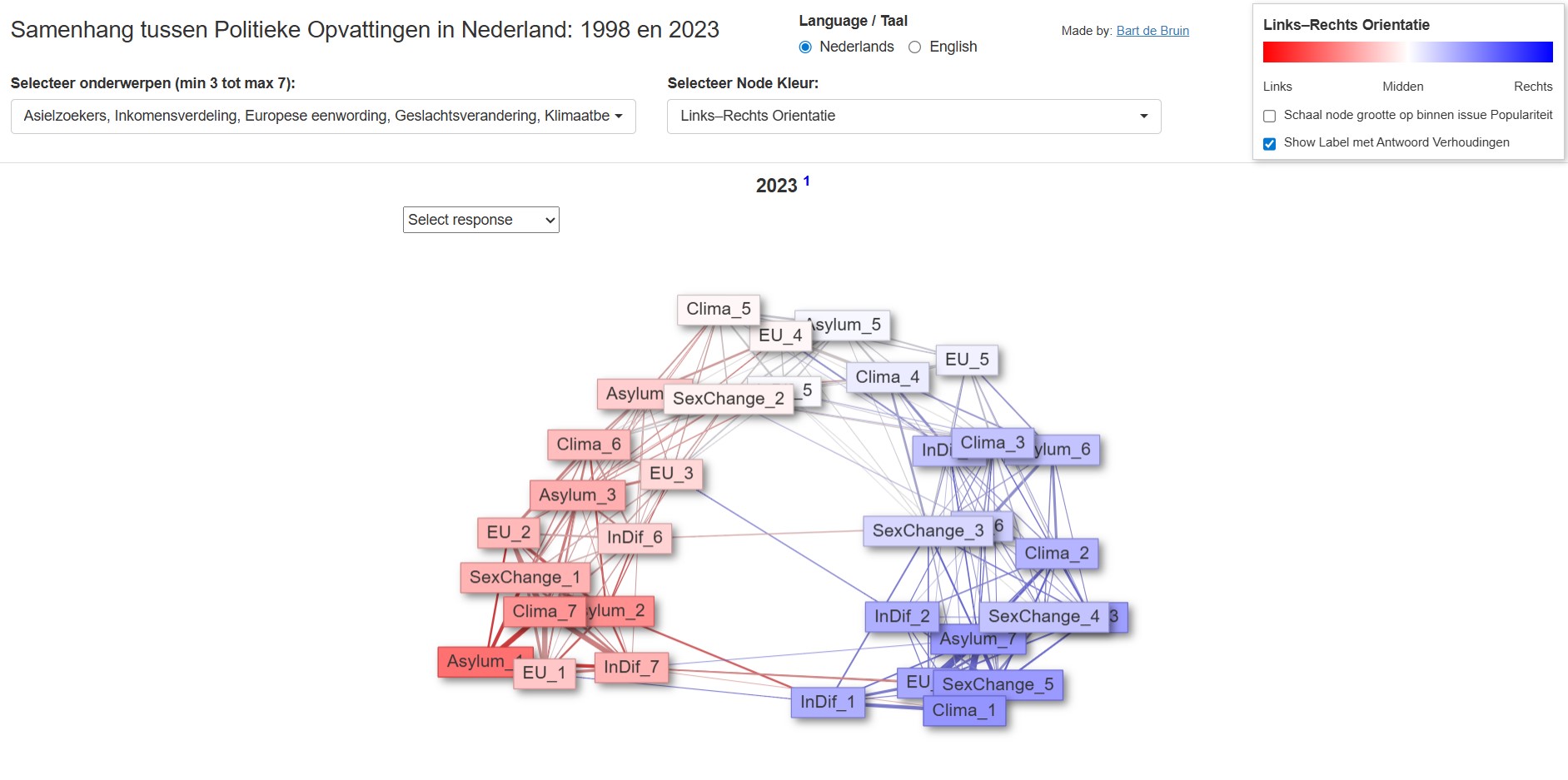
With this application you can analyze how polarized the Dutch political landscape really is. By applying the new method called Response Item Networks on all the Dutch Election Surveys between 1998 and 2023, I invite you to explore the temporal dynamics in Issue Polarization, Issue Asymmetry and Partisan Sorting on a variety of issues. For a full introduction about what polarization is, how Response Item Networks are constructed and how to use the application, please click on the left Video. After watching the video, you can access the interactive application by clicking on the thumbnail on the right!.

Publications

Contact